By Arkmeds
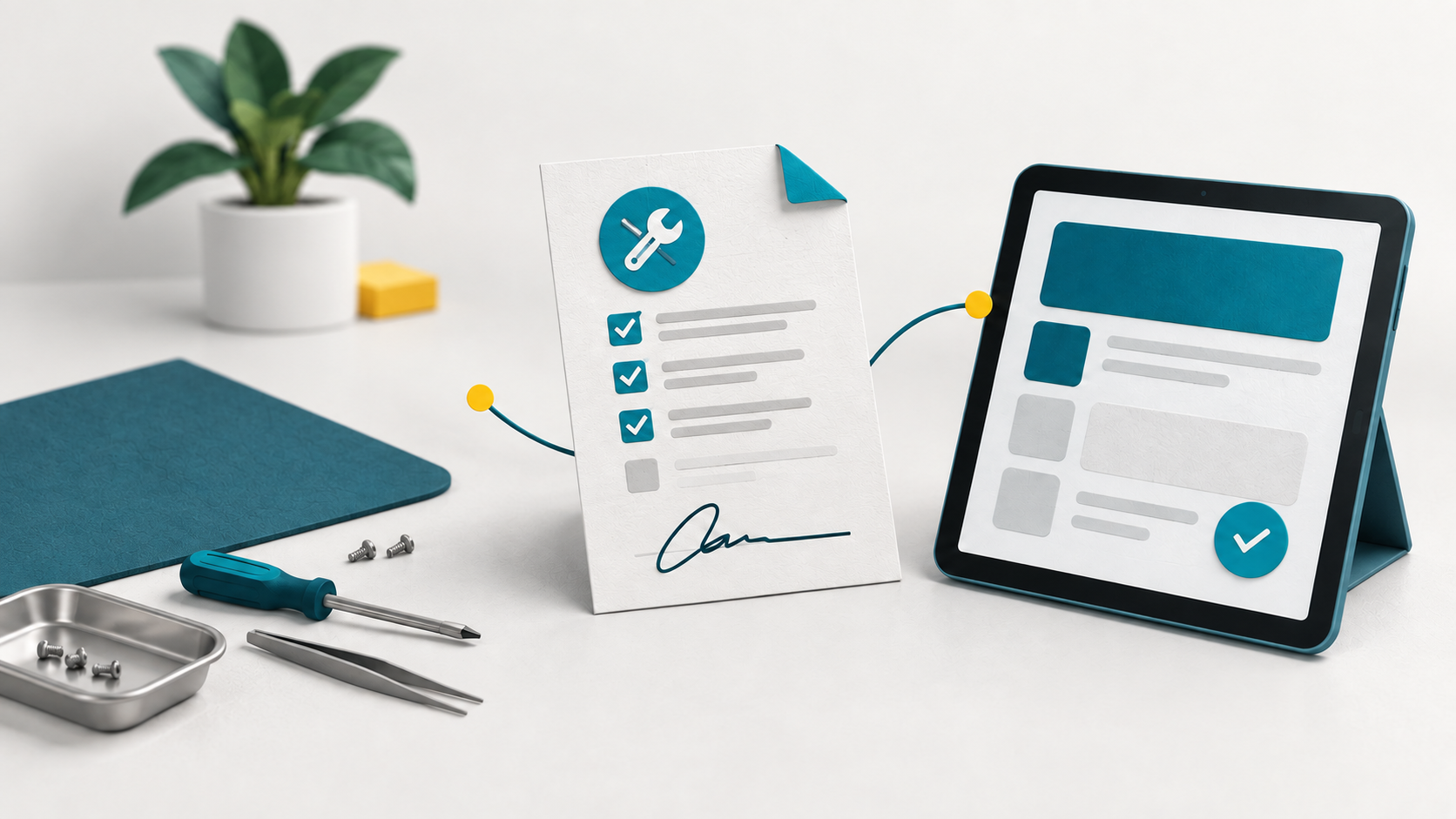
Connecting a test to its technical report means preserving the link between the measurement, the equipment assessed and the service performed. With Mark II, data from compatible analyzers can feed digital records; the CMMS uses work orders and service history to help teams follow an asset over time. The aim is a clearer path for retrieving, reviewing and delivering documentation. Arkmeds presents an integration that connects these stages of work. Explore the maintenance management platform.
To put this workflow to use, the team needs to decide what to record, who will review it and when a document is ready for delivery. Automated data entry is one part of the process. Record quality also depends on these decisions.
The roles of the analyzer, the app and the CMMS
The analyzer is the instrument used for testing. Mark II connects Arkmeds analyzers to digital records, while the CMMS organizes work orders and asset history. The Mark II overview, in Portuguese, describes this integration.
A sound implementation starts with asset identification. The asset ID, serial number and description should identify the equipment unambiguously. If a measurement is linked to the wrong asset record, a well-formatted document will still tell the wrong story.
What can be automated
In the integrated workflow, Bluetooth transfer of results can populate checklists and support PDF report generation. The Tesla product page presents these capabilities with Mark II. Confirm which fields and steps are automated for the model and configuration in use. Some service information comes from sources other than the analyzer.
Organizing the transition from data to a technical report
Before expanding the integration, review a document template with the team performing the service and the people receiving it. Ask which information would allow someone to understand the work without a follow-up conversation.
As a starting point, consider:
- Identification of the asset and the corresponding work order.
- Date, responsible professional and scope of the service.
- Identification of the instrument and reference to the procedure used.
- Results, units and observations needed to interpret them.
- Open issues, technical conclusion and responsibility for the applicable review.
This list is a guide to organizing documentation. Required fields depend on the service, institutional procedures and applicable technical references. A template should reflect the work actually performed, including its limitations.
During review, look for discrepancies between asset details, results and the conclusion. Automatically populated fields must also match the test context. When a correction is needed, retain enough information to show what changed and why.
What real incidents reveal about record quality
A study published in 2010 followed four weeks of activity at two locations of a teaching hospital in the Netherlands. Researchers received records for 911 of the 1,580 surgical procedures performed and identified 148 incidents involving equipment, instruments and materials. These incidents caused a total of 12 hours and 9 minutes of disruption to the surgical process. Only six of the 148 also appeared in the usual incident reporting system. The finding illustrates how targeted data collection can reveal problems that routine reporting may miss. Read the study by Wubben and colleagues.
The incidents were not all technical defects: they included availability, instrument, use and organizational problems. They do not establish a Brazilian or international incident rate. Responses covered only 57.7% of procedures; the single-institution setting and possible greater reporting when problems occurred limit generalization. The authors did not evaluate a CMMS or demonstrate that digitizing documents alone would prevent these incidents.
A practical management application is to build a history that distinguishes a reported symptom, a technical finding and a confirmed cause. For example, “did not turn on” describes an occurrence; a discharged battery, a damaged cable and no reproducible fault are different investigation outcomes. Preserve this distinction in the service record, along with the action taken and subsequent verification. When tracking recurrence, use a consistent event definition and an explicit denominator, such as equipment monitored or services completed. Counting work orders alone does not measure failure risk.
Offline work requires synchronization checks
Arkmeds describes a mobile workflow that supports working without an internet connection and synchronizing data once connectivity returns. This feature is described on the CMMS page.
Establish a routine check for services performed offline. The team should know which records remain on the device, which have reached the platform and which documents are available to view. For service providers, this helps distinguish completion in the field from delivery to the customer.
Include synchronization in your process assessment. A correctly performed service may still have an administrative issue if the expected document is not yet accessible to the responsible person.
What the adoption data shows
An internal Arkmeds analysis, consolidated on October 1, 2026, recorded 227 companies and 6,140 calibrations between July and September 2025, compared with 304 companies and 13,241 calibrations in the same quarter of 2026, within the analyzed subset of integration use.
These figures describe growth in adoption and recorded activity. They do not isolate the software’s effect on productivity, accuracy or quality, or attribute the increase in calibrations to a single feature.
To assess your own operation, track measures directly related to your goal: time from execution to delivery, documents returned for correction, incomplete asset records and services awaiting synchronization. Compare equivalent periods and keep each indicator’s definition consistent.
Continuing education is part of implementation
WHO’s 2025 guidance on information systems for inventory and maintenance includes staff training among implementation activities and resources for user training in sustaining the system. The focus extends beyond installing software to the people who record, interpret and use the data. Read the WHO publication.
In practice, recurrent questions and returned documents can become training topics: asset identification, interpreting manuals, recording limitations and checking records after synchronization. One approach is to review an anonymized real case, practice the workflow and check whether each participant can recognize an inconsistency. These are suggested workplace applications, not effectiveness outcomes measured by WHO.
Arkmeds Academy, brings together clinical engineering training options. When choosing a course, compare its content, audience and activities with the needs identified in your operation. Learning should complement instrument-specific training and institutional procedures, with opportunities to demonstrate what has been learned.
Watch the digital workflow presentation
The Portuguese-language video A nova era da Calibração e Manutenção Hospitalar: Digital, Rápida e Inteligente, published on the Arkmeds channel on April 28, 2025, covers the analyzer-to-app connection, offline work, QR codes and multiple signatures. Use the presentation to inform a discussion about your team’s workflow. English subtitle availability has not been verified.
Frequently asked questions
Does integration remove the need to review the report?
Review remains important. Check the asset association, scope, results and conclusion before delivery, following the process established by your team.
Can the team work without internet access?
Yes. The mobile workflow described by Arkmeds includes offline operation and later synchronization. During implementation, confirm which features and documents your routine requires in this mode.
Where should implementation begin?
Choose one type of service, review the asset records and validate a document template. Follow the first records from execution to delivery before expanding use.
Discuss integration for your operation
Want to assess the connection between analyzers, Mark II and maintenance management? Contact Arkmeds and describe your team’s equipment, services and documentation workflow.