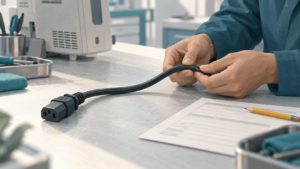
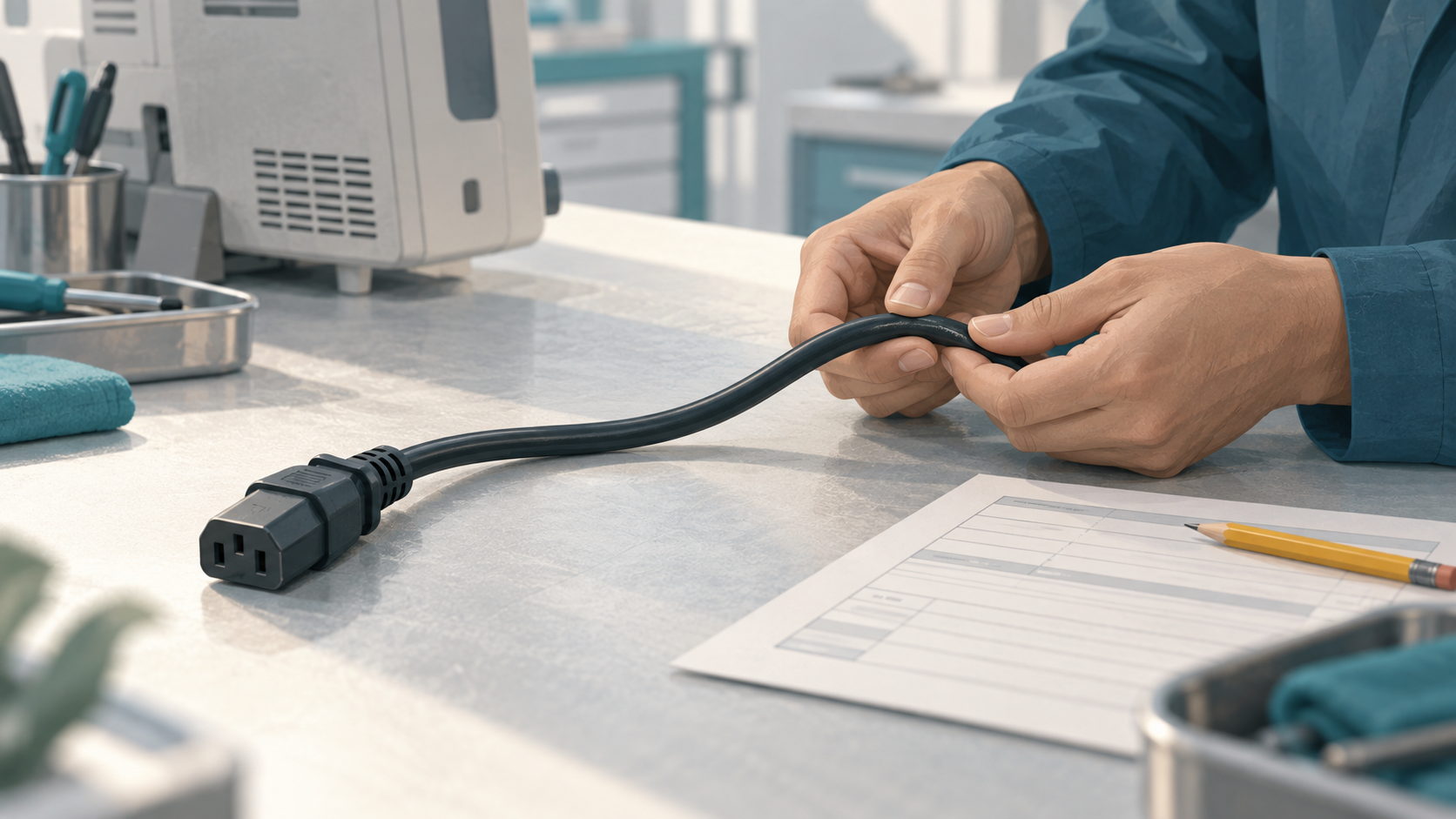
Cover: conceptual AI-generated illustration following the Arkmeds identity. It does not depict an actual test or measurement.
Before an electrical safety test, you need to identify the equipment and accessories being assessed and define the applicable procedure. In this article, we use Tesla, an analyzer from Arkmeds, as an example to discuss preparation, recording conditions and results, review and delivery. Test execution and technical decisions depend on the manuals, the procedure and what was actually assessed.
A power cord is replaced during maintenance. The next test passes, but the report does not identify the cord that was connected. Months later, reconstructing the work becomes difficult. This illustrative situation shows why the record should follow the assessed assembly, rather than only the asset number.
Why does power cord identification matter?
At one public hospital in Curitiba, Nunes and colleagues analysed 393 valid tests: 363 initial tests and 30 retests, between January 2024 and March 2025. Of 25 protective earth resistance failures, 18 were attributed to the power cord: 72% of this failure category, not 72% of the fleet. The study covered non-permanently installed devices and did not evaluate Tesla. Original study, results, pp. 5–6.
| Within the 25 protective earth resistance failures | Cases | Share of this group |
|---|---|---|
| Attributed to the power cord | 18 | 72% |
| Other attributions, calculated by difference | 7 | 28% |
| Category total | 25 | 100% |
Seven cases is an editorial calculation: 25 − 18. The distribution does not estimate risk at other hospitals or analyzer effectiveness. Also, 18 cord attributions does not mean 18 cord replacements: Table 6 records 16 replacements among the corrective actions. A finding, an attributed cause and an intervention are different information.
The practical implication is to identify the detachable cord and accessories included in the test, where applicable. If something changes, link the new result to the new configuration and preserve the earlier record. This helps distinguish an intervention from a different accessory or test condition.
What should be defined before testing?
IEC 62353:2014, edition 2 addresses testing before entry into service, during maintenance and inspection, after repair and on recurrent occasions. Its catalogue states that this scope does not demonstrate design conformity with IEC 60601-1. The international reference alone also does not establish a local legal obligation.
Confirm the asset identity, instructions for use, protection class and relevant applied part types. Equipment class and applied part type are separate classifications; use the manufacturer’s documentation and markings. The chosen method should match the actual configuration. Do not copy a numerical limit from another device merely because the test has the same name.
| Preparation decision | What to check | What to preserve in the record |
|---|---|---|
| Assessed assembly | Asset, cord and relevant accessories | Identifiers and changes to the assembly |
| Procedure | Reference, edition, method and applicability | Name, version and criteria used |
| Instrument | Identity, condition and relevant metrological documentation | Serial number and document reference |
| Execution | Inspection, connections and conditions specified in manuals | Relevant conditions, exceptions and items not performed |
The Tesla User Guide in the official manual library calls for inspection before and after use, checking accessories for damage and using the designated connectors. The analyzer must not be connected to a patient. These are preparation considerations; this article does not replace the manual for the instrument and procedure in use.
What does “+100 MΩ” mean on Tesla?
According to the official FAQ, “+100 MΩ” indicates insulation resistance above 100 MΩ. It expresses a range, not an exact value of 100.0 MΩ. Preserve that information when transcribing or exporting the result: changing “above” to “equal to” changes its technical meaning.
Text shown by the manufacturer
Above 100; not equal to 100
Method, conditions and reference version
Do not invent a value such as 150 MΩ to fill the field. One documentation approach is to retain the original indication and its meaning in the report. Comparison requires the applicable criterion and test conditions; this reading alone does not establish every requirement for returning the device to use. Manufacturer FAQ, in Portuguese.
How does a smartphone help produce the report?
Once asset records, procedures and criteria are ready, automating result transfer becomes useful. Tesla provides an intuitive interface, a 7-inch screen and Bluetooth communication. The consulted manual describes automatic tests through the app, with values transferred to the management system; the operational guide documents Android use. Official manual, in Portuguese.
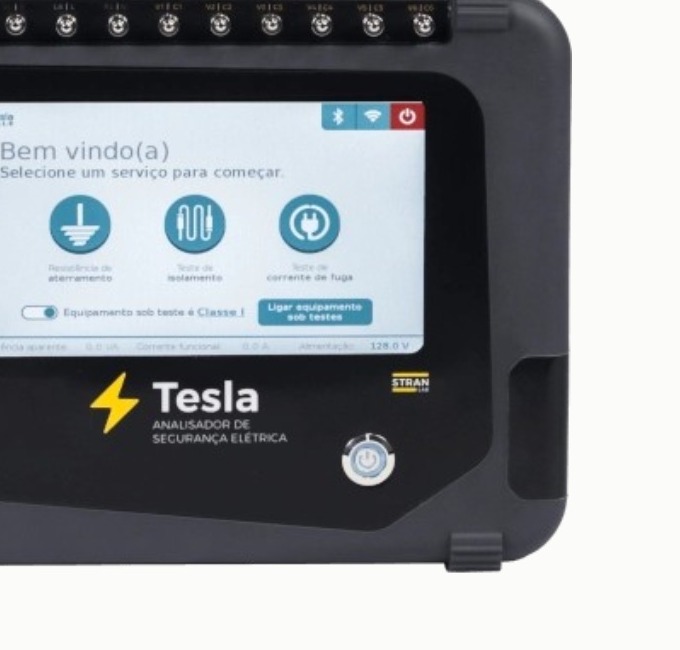
In the workflow documented by Arkmeds, the team prepares the customer, asset, procedure and work order. The technician synchronizes app data, selects the job and starts the configured sequence, with confirmation on the analyzer. Testing can run without internet access, followed by synchronization once connected. Local Bluetooth communication and platform synchronization are separate stages.
Identify the assembly and procedure.
Use the configured sequence and record conditions.
Synchronize, check the conclusion and pending items.
Issue the reviewed version and confirm the recipient.
The benefit is reaching a document without manually reconstructing each reading. With a configured workflow and reviewed results, the report can be prepared in minutes, electronically signed and sent to the customer, using the features described by the manufacturer. This timing concerns document preparation under those conditions; it is not a universal duration for every test or service.
Tesla was designed to support technical work with intuitive operation and robust construction, according to the manufacturer’s description. Care depends on the manual; robustness does not replace inspection or protection from unsuitable conditions.
Explore Tesla and its testing and documentation workflow
What should the report contain?
Use this adaptable model to organize the links needed to review the work. Actual fields depend on the device, procedure and applicable requirements.
| Record block | Information to record | Question another person should be able to answer |
|---|---|---|
| Identification | Asset, work order, assessed cord and accessories | Which assembly was tested? |
| Execution | Date, operator, procedure and version | Who performed it, using which reference? |
| Instrumentation | Analyzer and relevant metrological reference | Which instrument produced the result? |
| Conditions and results | Method, configuration, units and qualifiers such as “>” | Under which conditions, with which indication? |
| Assessment | Criterion, conclusion and explanation of exceptions | What was compared, and what remains pending? |
| Follow-up | Correction, retest, review and release responsibility | What is the next step? |
| Delivery | Issued version, planned signatures and recipient | Which document was delivered, and to whom? |
The UK guidance MHRA, Managing Medical Devices, January 2021 recommends retrievable records that preserve earlier changes (§2.4) and adequate safety and performance testing before return to service after repair (§8.7). This is UK guidance, used here as a management reference rather than a universal legal requirement.
Illustrative example: preserve the earlier result
Consider a fictional job where the initial test raises an issue involving the cord. The team records the finding, documents the authorized intervention, identifies the updated assembly and retests according to the procedure. The report keeps both records, with a conclusion explaining their relationship. The later result does not erase the earlier issue. This example contains no measurements or customer case.
Separate three decisions: a result answers the test performed; a conclusion compares it with a criterion; release also considers the other requirements of the service. A customer’s acknowledgement signature confirms a delivery stage and does not replace technical review.
Common workflow questions
Which leakage current methods does Tesla use?
The consulted official FAQ states the direct method. This helps check compatibility with the chosen procedure; it does not make direct, differential and alternative methods interchangeable. Consult the manual and configuration for your version. Product FAQ, in Portuguese.
If the report has not appeared on the platform, was the test lost?
Absence from the platform alone does not demonstrate loss: the guide permits offline execution and later synchronization. Check the job state and synchronization before repeating the work. If the issue persists, contact support; do not record a second execution as though it were the first.
Does an electrical safety report demonstrate calibration and performance?
These are separate assessments. Identify the scope performed and any additional items required. For a research example on that distinction, see return to use after repair.
Sources and further reading
- Nunes et al. (2026), Implementation of IEC 62353:2014 — estudo original
- IEC 62353:2014, edição2 — catálogo oficial e escopo
- Arkmeds — Guia do Usuário Tesla (arquivo Tesla 2022 PTB.pdf)
- Arkmeds — biblioteca oficial de manuais
- Arkmeds — guia operacional Tesla e aplicativo
- Arkmeds — Tesla, perguntas frequentes e produto
- MHRA — Managing Medical Devices, v1.3, janeiro2021
Research and review: 6 October 2026. Visuals and record model: Arkmeds editorial work. Chart based on counts published by Nunes et al.; 7 = 25 − 18 is our calculation. The described case is fictional.
Original archive date: 2026-10-04. Editorial date reorganized on 8 October 2026.