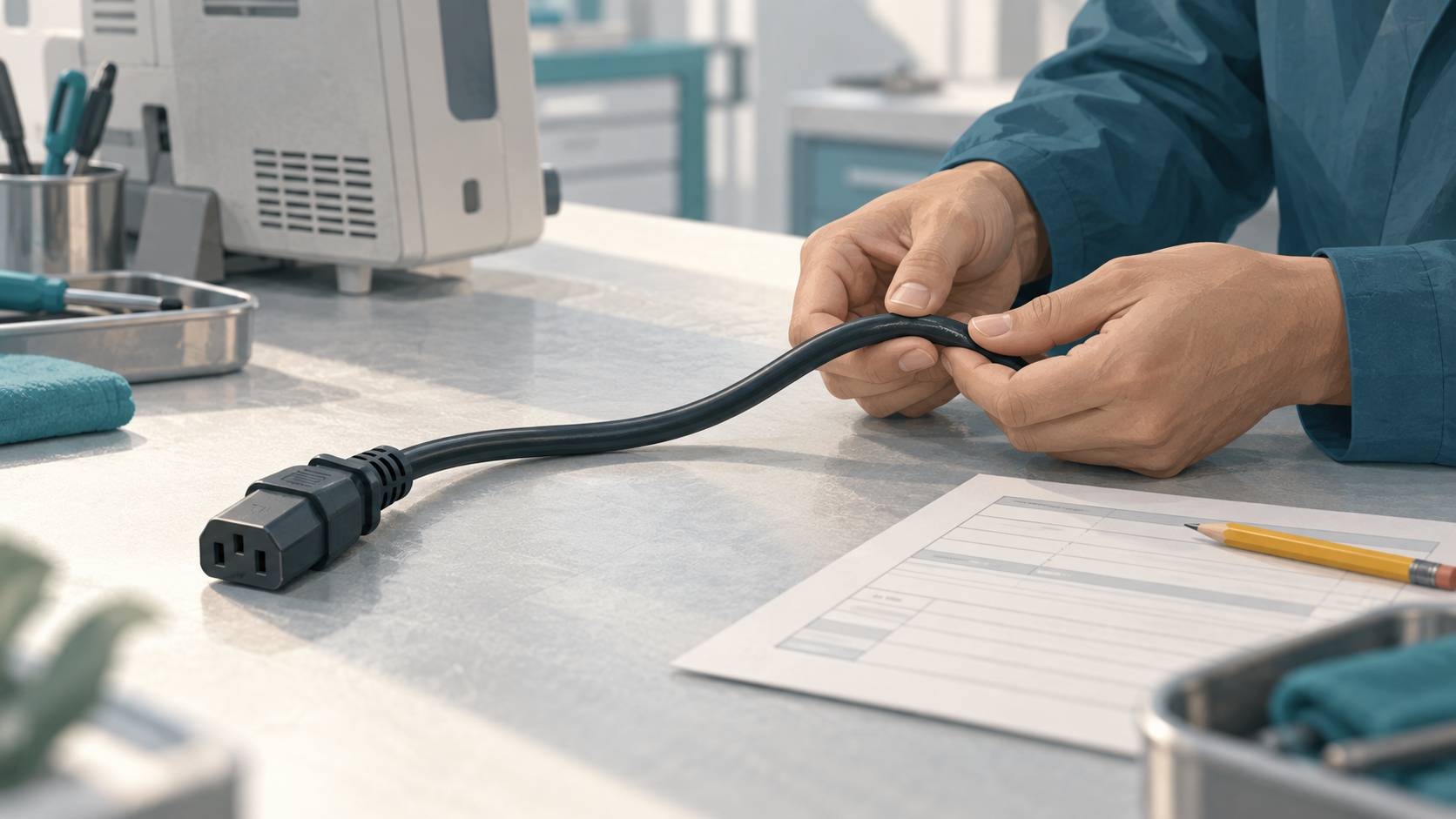
AI-generated editorial illustration: inspection of a disconnected power cord and documentation of the verification. It does not depict a real test.
The monitor displays a waveform again, its connector has been repaired and the work order is nearly closed. Is the device ready to return to service? In this illustrative case, restoring function is only part of the answer. Research on post-repair testing shows why the accompanying cord and the release record also deserve attention.
The answer in brief
Restored function alone does not complete the verification. Before releasing repaired equipment, collect the applicable electrical-safety and performance results, identify the device and accessories evaluated, and record who authorised release. IEC 62353 addresses recurrent and post-repair testing; selecting the checks also depends on the device and the manufacturer’s instructions. [2][4]
What did the 2026 hospital study find?
Nunes and colleagues reported 393 tests: 363 initial tests and 30 retests, at one public hospital in Curitiba, Brazil. Data were collected from January 2024 to March 2025. Reported nonconformity rates were 23.7% after repair and 7.7% in recurrent testing. [1]
That is a 16-percentage-point difference, calculated from the published rates. It does not prove that repairs caused the failures: the groups differ and are not a controlled before-and-after experiment. For the technical team, the useful question is whether closing the work order includes evidence of verification after the intervention or only a description of the repair.
Why should the power cord be part of the investigation?
Power cords accounted for 18 of 25 protective-earth resistance failures in the study. That is 72% of this failure category, not 72% of tested equipment. [1]
Attributed to the power cord
72%
A separate Indian study examined 200 Class I devices. In a 20-device subset, median earth resistance was 84.5 versus 580 mΩ with medical-grade and supplied non-medical-grade cords respectively. The results cannot be pooled with the Brazilian rates. [3]
A failure attributed to a cord is not automatically an internal device defect. Keep the evaluated cord, initial finding and any accessory change identifiable during the investigation. If the cord changes between testing and handover, record that change: a context-free “pass” loses part of its meaning.
How long did testing take, and can that be a local target?
The reported mean was 5.34 minutes, SD 1.71, across 363 initial tests, including preparation and documentation. [1] Treat it as context, not a promised turnaround. To plan locally, measure preparation, applicable checks and record completion separately, then identify which stage consumes time.
What is the difference between IEC 62353 and IEC 60601-1?
IEC 62353 concerns safety assessment during the equipment's service life. IEC 60601-1 concerns basic safety and essential performance requirements. A satisfactory post-repair test is not a certification of design compliance. [2][5]
| Reference | Scope | Practical consequence |
|---|---|---|
| IEC 62353:2014 · edition 2.0 | Recurrent and post-repair testing of medical electrical equipment and systems. | Select the applicable in-service testing procedure. |
| IEC 60601-1 · consolidated edition 3.2 (2020) | Basic safety and essential performance; applicable particular standards also matter. | Do not equate a routine pass with full design compliance. |
| Device manufacturer's documentation | Instructions for the specific model and intervention. | Record the document and revision used to select checks. |
These are scope summaries, not a reproduction of the standards. A numerical limit needs its method and configuration; do not copy a value from one study into every equipment checklist. National adoptions and legal duties require their own jurisdiction-specific verification.
Does a functional check replace an electrical safety test?
No: performance and electrical safety answer different questions. WHO distinguishes performance inspection from safety inspection. The MHRA recommends applicable electrical-safety and performance testing before return to service; this is UK guidance, not a statement of Brazilian legal requirements. [6][4]
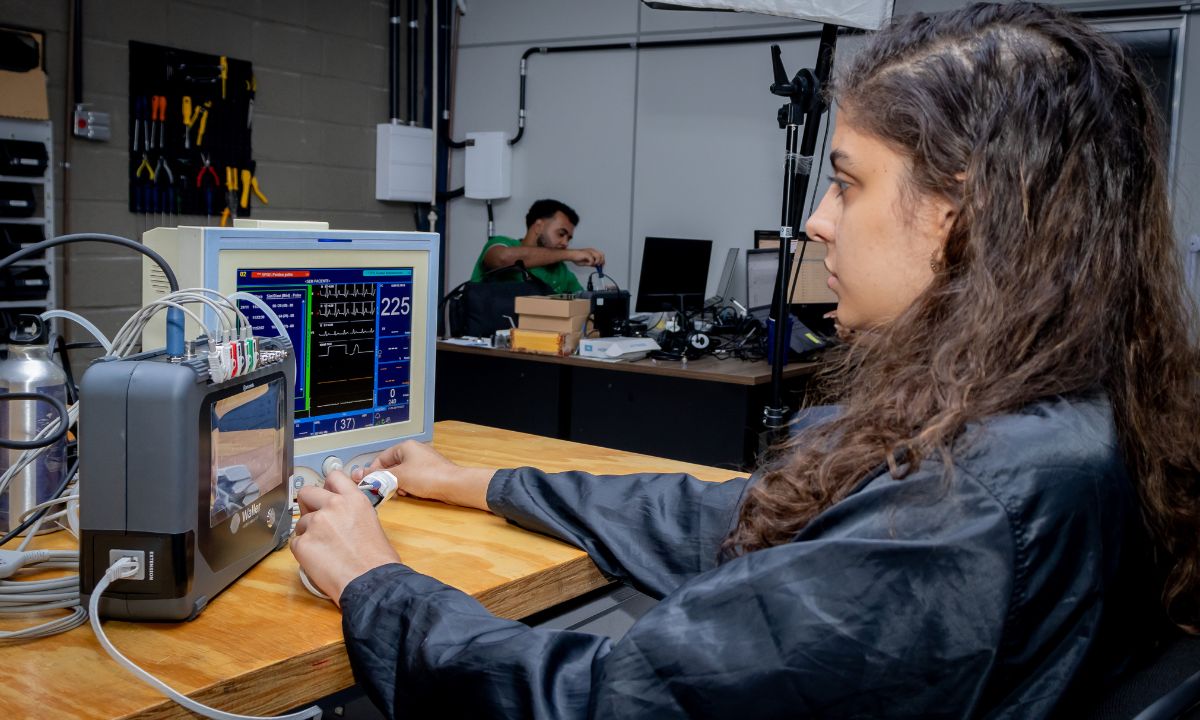
For a monitor, displaying a waveform helps answer whether a function responds. It does not answer the same question as an earth-resistance or leakage-current result. A useful handover links both sets of evidence to the device, without treating one as a substitute for the other.
Which checks matter before return to service?
The following is a map of questions and evidence, not an execution sequence. Applicability, methods and acceptance criteria come from the technical procedure selected for the equipment.
| Area | Question to resolve | Evidence to preserve |
|---|---|---|
| Visual condition | What was inspected, including relevant accessories? | Findings and accessory identification. |
| Protective earth | Where applicable, which protective-earth path was assessed? | Measurement points, resistance and units (Ω or mΩ). |
| Leakage current | Which method and equipment/applied-part configuration were evaluated? | Measured current, units, configuration and criterion source. |
| Insulation | Is the measurement applicable to this device and intervention? | Selection rationale, method and result when applicable. |
| Performance | Do the relevant functions meet the selected specifications? | Function tested, reference/simulator, result and criteria. |
The same number can have different meanings under different configurations. Preserve the measured value and its context, rather than only exporting a green pass label. The research's equipment and methods are described in the original paper. [1]
How can an investigation be documented without losing the initial result?
Illustrative documentation example, using fictional identifiers and no invented readings: monitor MON-014 has had a connector repaired. Its functional check is recorded, but initial test IN-01 identifies a protective-earth nonconformity. The device remains pending release while the team investigates under the applicable procedure.
| Stage | What the record needs to let a reviewer reconstruct |
|---|---|
| Initial finding | IN-01 linked to MON-014 and cord CAB-01; values, units, method, configuration and criterion are completed using the actual results. |
| Investigation and correction | Record what was examined and the technical reason for the action. If a cord is replaced, identify the previous and new accessories, for example CAB-01 and CAB-02. |
| Retest | RT-02 linked to IN-01, identifying the accessory actually evaluated and the results of applicable checks. The original record remains available. |
| Decision | Authorise release or retain the device based on the complete evidence and procedure; record the responsible person, date and communication to the user. |
The example shows how to preserve the chain of evidence, without diagnosing the cause or authorising release after a cord replacement. A later technician can see what changed between the initial test and retest. MHRA guidance calls for retrievable records and changes that do not obscure earlier information. [4]
What should a post-repair release record contain?
The case above shows how to link an initial finding to its retest. The table below expands that into the information needed to reconstruct the release decision. Its fictional MON-014 example is a documentation aid, not a measured test result.
| Field | Example of useful documentation |
|---|---|
| Asset and intervention | Asset MON-014 (fictional); model/serial; repair order; connector replaced. |
| Procedure and configuration | Procedure ID/revision; equipment class and applied-part type; accessories and method used. |
| Results and criteria | Measured value + unit; acceptance criterion + source; result of each applicable check. |
| Test equipment | Analyser/simulator ID and applicable calibration reference. |
| Initial test and retest | Link the finding, corrective action and later verification; retain both records. |
| Release decision | Release/hold decision; responsible person; date; communication to the user. |
A later pass should not erase an earlier failure. Preserve the history so a reviewer can follow the decision without relying on someone's memory. This template is an editorial implementation aid; MHRA §§2.4 and 8.7 discuss retrievable records and return-to-service testing. [4]
How does Tesla take a test through to a signed report?
Once the checks are defined, the next task is to keep measurements linked to the equipment and turn them into a report for the client. This is where a connected analyser can support the workflow.

- Connect and run: select the equipment and procedure in the app, then start automated testing through Bluetooth. [7][9]
- Record without retyping readings: results populate the report and remain linked to the equipment. [8]
- Generate the report in minutes: after measurements and review, the PDF is generated automatically. Total time varies with the checks and workflow configuration. [7][8]
- Sign and deliver: the report can be electronically signed and made available to the client; the workflow also supports the requester’s remote signature. [8][10]
Operation is designed to be easy and intuitive, with a touchscreen, educational diagrams and customisable checklists. Its durable construction and compact format support technical work and transport. [7][9]
Data collection can work offline, with synchronisation once an internet connection is available. The connected workflow helps the team move from measurement to a document ready for review and delivery. [9]
Three questions for the next handover
- Which device and cord were actually evaluated? Identification connects the result to the tested configuration.
- Where are the results and criteria used? A pass indicator does not replace values, units and context.
- What changed between the failure and retest? Correction and subsequent verification need to be linked to the initial finding.
These questions turn the article into a concrete topic for a team review. The aim is to reconstruct a release decision, including when someone else takes over the work.
One more question about testing intervals
Is there one universal interval for every device?
Do not derive a universal interval from a study. MHRA §8.1 relates planned maintenance to manufacturer instructions, expected use and environment. Define and document the applicable local schedule. [4]
Sources and editorial responsibility
- Nunes, Barros & Carvalho (2026). Implementation of IEC 62353:2014. Research on Biomedical Engineering 42, 40.
- IEC 62353:2014 — official scope and edition.
- Padmavathi, Prasad & Kundra (2015). Does non-medical grade power cord compromise the safety of medical equipment?
- MHRA (2021). Managing Medical Devices, §§2.4, 8.1 and 8.7.
- IEC 60601-1:2005+AMD1:2012+AMD2:2020 — consolidated edition 3.2.
- WHO (2011). Medical equipment maintenance programme overview.
- Arkmeds — Tesla technical product information.
- Arkmeds (2025) — Mark II: Bluetooth, reports and electronic signatures.
- Arkmeds — Tesla guide: Android app operation and offline use.
- Arkmeds — Tesla: digital delivery and client signature.
By Thiago Bajur, CEO of Arkmeds. Published research, official scope summaries and an explicitly illustrative record template support this editorial article. Arkmeds manufactures Tesla; none of the cited research is presented as a Tesla evaluation. Source figures and data are credited at their point of use. CC BY 4.0.