By Arkmeds
An electrical safety test should begin with a defined scope and end with a record that explains what was assessed. Tesla, the Arkmeds electrical safety analyzer, offers automatic and manual tests, a touchscreen interface and Bluetooth connectivity with Mark II. These features support testing and documentation; their use must follow the manufacturer’s instructions and the technical procedure established for the equipment under test. Explore Tesla.
For managers and clinical engineering teams, the practical question is how to organize this work consistently. Preparation, selection of references, review of results and follow-up on open issues all matter. This article addresses that organization. It does not replace training, a manual or a test procedure.
Define the scope before selecting the test
Start by identifying the equipment and the reason for the service. A record should explain which asset was assessed, in what context and for what purpose. Avoid relying on generic descriptions such as “monitor” or “pump” when the inventory contains similar units.
When preparing the documentation, the responsible team should identify the applicable procedure, the documentation for the equipment under test and the analyzer’s instructions. It also needs to establish who can answer questions or assess situations the procedure does not cover.
This preparation helps avoid improvised changes during the task. If the available documentation does not resolve a question about application or compatibility, obtain technical guidance before proceeding. Arkmeds provides an analyzer manuals section.
Be precise about standards
In Tesla’s Brazilian product FAQ, Arkmeds states that the analyzer was developed with ABNT NBR IEC 62353 in view and uses the direct method for leakage current testing. Read these statements within the scope described by the manufacturer. Consult the Portuguese product FAQ.
ABNT NBR IEC 62353 is the Brazilian reference cited by the manufacturer; it should not be treated as a universal regulatory requirement. When preparing a service, record the reference and edition used in your team’s procedure. Confirm their applicability to the equipment, the purpose of the test and the jurisdiction in which the work takes place. A standard mentioned on a commercial page does not, by itself, document every condition of a particular service.
Avoid replacing a description of the work performed with a generic statement of compliance. A useful document shows the scope assessed, the criteria adopted and the relevant results. The technical conclusion must be consistent with that evidence and the limitations observed.
Evidence from Brazil highlights the power cord
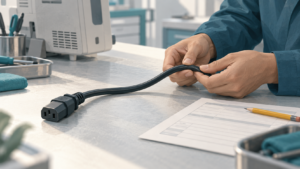
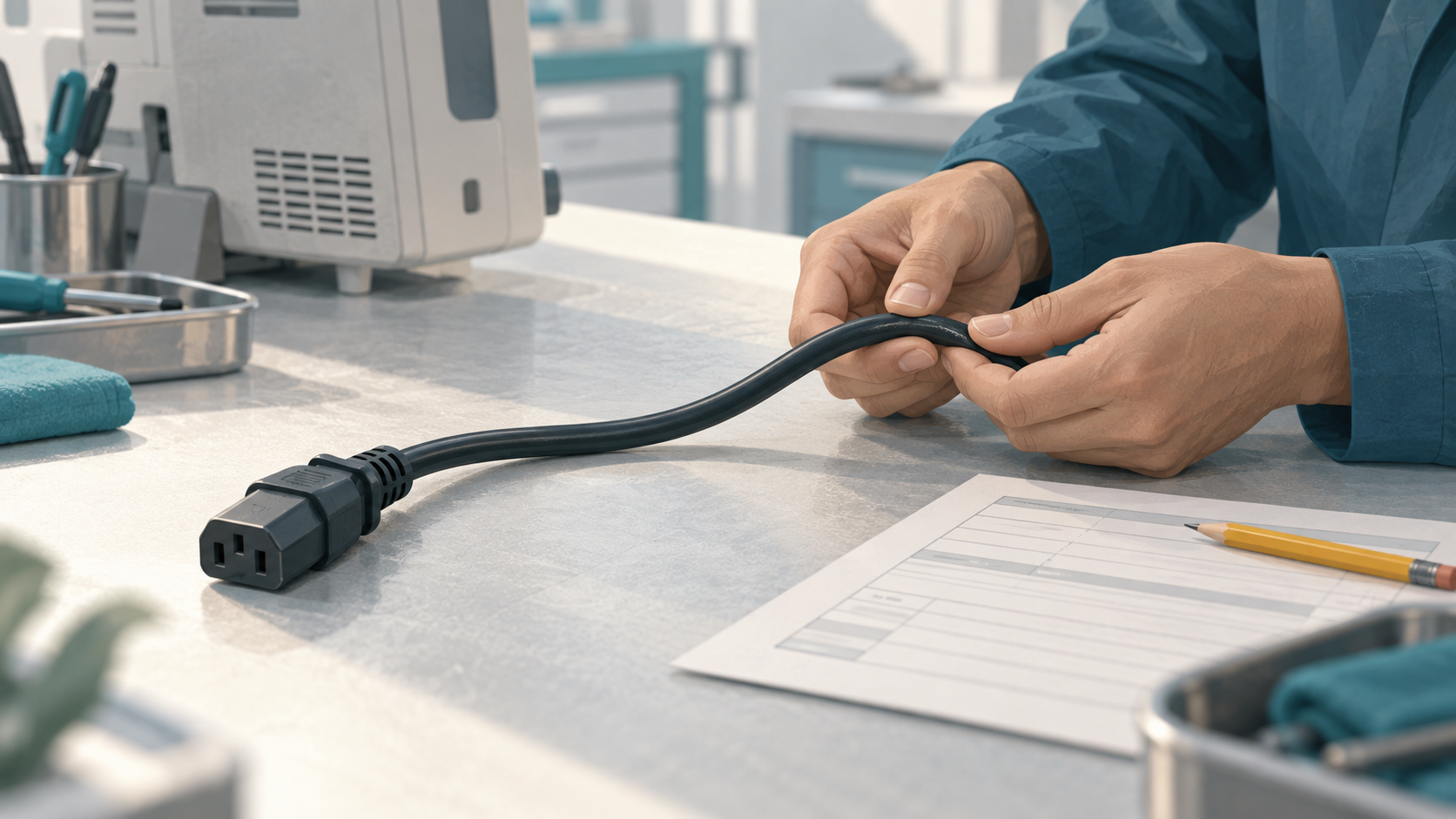
A study published in July 2026 evaluated the implementation of recurrent and post-repair tests at a large public hospital in Curitiba, Brazil. Data collected between January 2024 and March 2025 comprised 393 valid records: 363 initial tests and 30 retests. Among the findings, the authors described 25 occurrences of protective conductor resistance above the criterion used in the study; 18 were attributed to the power cord. Read the full study by Nunes, Barros and Carvalho.
The finding draws attention to components that may receive less attention than the equipment’s main functions. It does not mean that 18 patients suffered electric shocks, or estimate accident frequency in Brazil or elsewhere. This was an investigation in one hospital, involving equipment that was not permanently installed and local selection and testing conditions. The inclusion of retests also means that each record should not be counted as a separate device.
A practical application is to ensure that the test record identifies the configuration actually assessed, including relevant accessories and interventions. If a cord was replaced, document the finding and the result of the subsequent verification under the applicable procedure. The history can then distinguish the initial finding, the correction and the final observed condition. Measurements and conclusions must remain linked to the method and criteria used for that service. Research figures do not replace the technical limits applicable to your equipment. The study did not evaluate Tesla or demonstrate the effectiveness of an Arkmeds product.
Organize the workflow without losing context
Tesla offers integration with checklists and PDF reports through the Mark II ecosystem, alongside offline work and subsequent synchronization. The official product page describes these features.
Before standardizing screens or templates, assign responsibilities. Decide who prepares the asset record, who performs the service, who reviews the information and who follows up on an open issue. One person may cover several roles depending on the operation’s structure, provided responsibilities are clear.
Agree on how to record interruptions, identification questions and steps that were not performed. An empty field might indicate an omission, an inability to complete a step or an item outside the scope. Without an explanation, someone reading the document later cannot distinguish between these situations.
What to check before completing the documentation
Use these questions as a starting point for document review:
- Does the recorded asset match the equipment actually assessed?
- Does the document identify the responsible professional, date and instrument used?
- Can the procedure and technical references be identified?
- Do results include units and the context needed for interpretation?
- Do observations and open issues have clear follow-up actions?
- Does the conclusion match the scope actually completed?
Adapt this review to institutional procedures. It does not define acceptance limits, connections, test sequences or conditions for returning equipment to service. Those decisions belong to the applicable technical process and responsible professionals.
When a PDF is generated, check the final file as well. Verify that identification, results and observations appear correctly and that the document is linked to the appropriate service. The existence of a file alone does not demonstrate that review is complete.
Video on electrical safety and documentation
The Portuguese-language video Como fazer um teste de segurança elétrica na prática — 2025, published on the Arkmeds channel on January 13, 2025, includes chapters on documentation, Tesla and a practical demonstration. The documentation chapter begins at 03:33, and the Tesla introduction at 04:33. English subtitle availability has not been verified.
Use this material to become familiar with the subject. The video’s duration does not represent the time required to perform a test, and a demonstration does not replace an assessment of the service conditions.
Frequently asked questions
Does automatic testing eliminate preparation?
Preparation remains necessary. Identification, procedure selection, execution conditions and result analysis must form part of the qualified team’s work.
Does a PDF report prove compliance on its own?
PDF is the record’s file format. The conclusion depends on the content, scope, references and documented technical assessment.
Where can I find instructions for using Tesla?
Consult the manuals provided by Arkmeds and the documentation applicable to the equipment under test. Refer operation or compatibility questions to technical support.
Assess Tesla for your workflow
Contact Arkmeds to discuss Tesla’s features and its integration with Mark II. Describe your equipment portfolio and your team’s documentation needs.