
Cover: conceptual AI-generated illustration following the Arkmeds identity. It does not depict an actual test or measurement.
Compare repair and replacement when both are technically acceptable; then compare future costs, availability and ability to meet the clinical need over the same horizon. A fixed percentage of purchase price does not resolve this decision. A cheap option that cannot safely return to use should leave the comparison.
A part costs R$8,000. A new device costs R$24,000. Repair seems the obvious choice. But how long does each option leave the service uncovered? Will parts and support remain available? Does the new device require training, accessories and consumable changes? These questions belong before budget approval.
Before price, there are disqualifying conditions
The MHRA’s Managing medical devices, 2021, section 10, links replacement planning to reliability, history, clinical and technical obsolescence, support and spare-part availability and downtime impact. It is a UK management reference, not a universal economic or legal rule.
| Condition to investigate | Decision question | Consequence |
|---|---|---|
| Safety and field action | Is an identified risk or manufacturer action applicable? | Resolve the restriction before comparing price |
| Recoverability | Can repair restore necessary requirements and be assessed? | Without relevant demonstration, do not treat it as released |
| Support and parts | Is viable support available over the intended horizon? | Consider actual availability, not just today’s part |
| Clinical suitability | Does the function still meet service needs and current requirements? | A working device may not meet the need |
| Continuity | Is a reserve, alternative or temporary solution available? | Include timing and impact in planning |
Age is a signal to investigate, not an automatic verdict. An older asset can have adequate support and performance; a newer one can have a relevant restriction. Preserve the technical rationale, especially when it eliminates the cheapest option.
How can you demonstrate that repair resolved the problem?
MHRA section 8.7 addresses assessment before return to service: performance and electrical safety where applicable, with results and changes communicated to the user. “It switches on” does not document every relevant requirement. WHO also distinguishes performance inspection, safety inspection and maintenance. Define scope according to the device, intervention and applicable instructions; an isolated test is not general clearance.
What does a maintenance study teach about total cost?
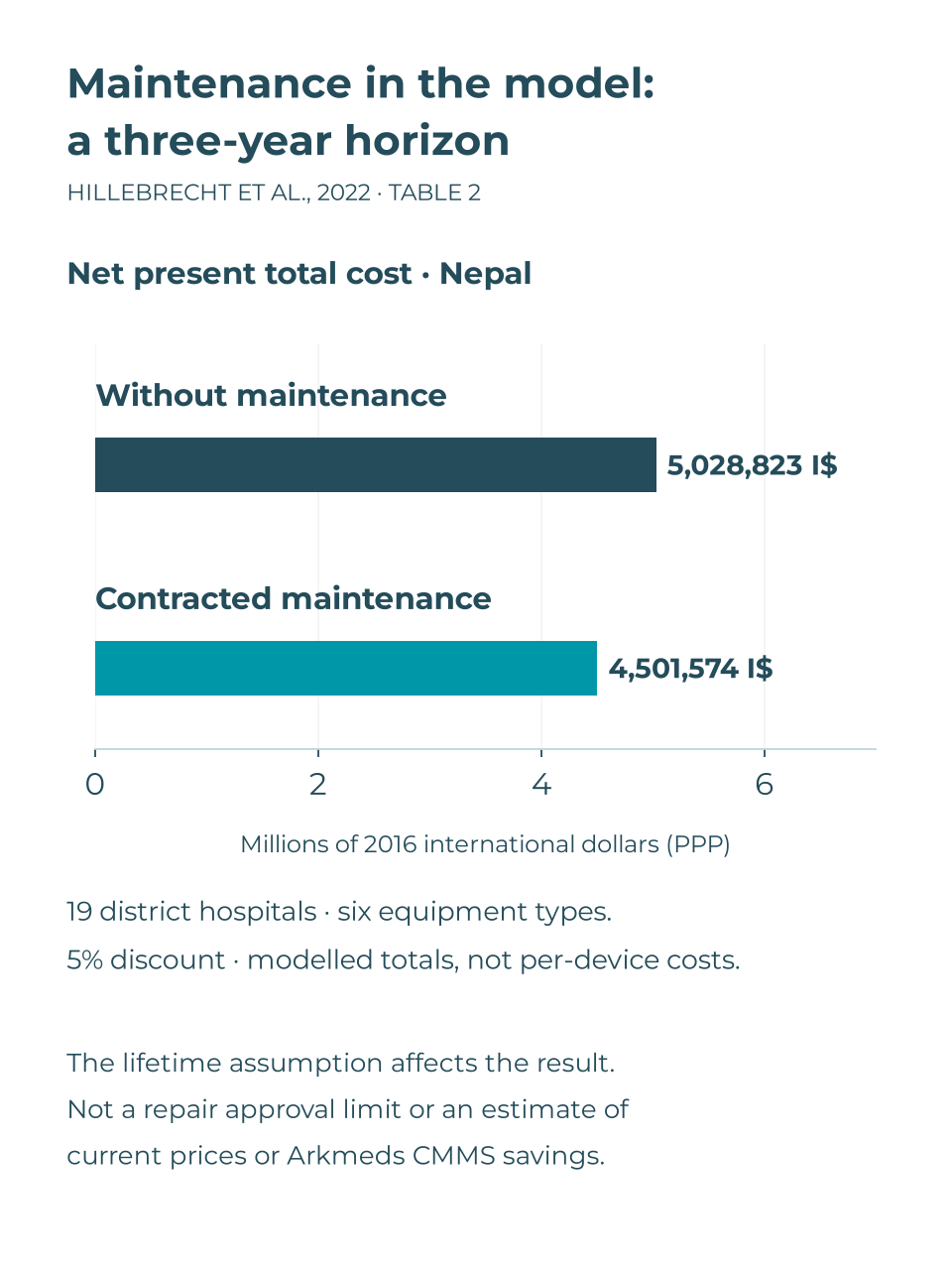
Hillebrecht and colleagues, 2022, modelled scenarios for six equipment types in 19 Nepalese district hospitals. Over three years, net present costs were I$5.03 million without maintenance and I$4.50 million with contracted maintenance, in 2016 international dollars with a 5% discount rate.
| Study scenario | Three-year net present cost, 2016 I$ (PPP) |
|---|---|
| Without maintenance | 5,028,823 |
| Contracted maintenance, invoiced costs | 4,501,574 |
The pilot generated data between 2010 and 2014. “Without maintenance” was a hypothetical alternative with replacement after faults were identified, not a recommendation to keep faulty devices in use. The comparison combines invoiced costs, administrative records and assumptions; it is not a randomized trial of individual repair-versus-purchase decisions.
The full values were 5,028,823 and 4,501,574: a difference of 527,249, approximately 10.5%, calculated here from the study table. These are modelled scenario totals, not per-device costs or Brazilian real prices.
A key assumption was a 39% reduction in lifetime without maintenance, derived from literature. This was not an observed lifetime extension of that percentage. Conclusions depend on assumptions and context. The article creates no “repair up to 50% of purchase price” rule and demonstrates no Arkmeds CMMS savings.
The useful contribution is comparing complete trajectories. A maintenance expense can reduce future replacements in the model; focusing only on the immediate quotation would miss that effect. For your fleet, inputs must come from actual contracts, history and needs.
The horizon itself changes the interpretation: in year one, no maintenance was I$223,140 cheaper than the contracted model; by year three, the comparison had reversed. A lower initial cost can become a higher accumulated cost. This does not establish a payback period for another hospital, but explains why the horizon should be stated before alternatives are compared.
How should options be compared over the same horizon?
Select a period consistent with planning and describe the service that must remain available. List each option’s future costs, maintaining the same price basis and temporal treatment. The original purchase price is already incurred, and should not be added again to future repair cost.
| Future component | Repair | Replace |
|---|---|---|
| Initial intervention | Part, labour and post-repair assessment | Purchase, installation and commissioning |
| Operation | Planned maintenance and relevant consumables | Contract, maintenance and new consumables |
| Continuity | Repair lead time, reserve or rental | Delivery time, transition and temporary solution |
| Team | Guidance needed after intervention | Training and workflow change |
| End of horizon | Decommissioning and relevant residual value | Decommissioning and residual value on the same basis |
| Uncertainty | Recurrence, parts and support | Delivery, adaptation and uncovered costs |
Do not mix spending with lost revenue without explaining the basis, or count the same downtime twice. For longer analyses, treating cash-flow timing and discount consistently can change the comparison. The example below uses undiscounted nominal amounts to make the calculation transparent.
A complete three-year example
This illustrative case represents no customer, quotation or Arkmeds-achieved savings. It assumes both options passed technical assessment and meet the same need. Currency is Brazilian reais (R$), retained consistently across translations.
| Item, in R$ | Repair | Replace |
|---|---|---|
| Initial repair / purchase | 8,000 | 24,000 |
| Installation and training | 0 | 2,000 |
| Planned maintenance over three years | 6,000 | 3,000 |
| Temporary solution and accounted downtime | 6,000 | 1,000 |
| End-of-period residual value | 0 | −2,000 |
| Undiscounted future total | 20,000 | 28,000 |
With these inputs, repair’s future cost is R$8,000 lower. Timing, capability and uncertainty still matter. If an additional R$12,000 of repairs emerges beyond maintenance already included, repair reaches R$32,000 and exceeds replacement by R$4,000.
At what point do the costs become equal?
Keeping other inputs unchanged, equality occurs when 20,000 + extra cost = 28,000: the extra cost is R$8,000. Below that amount, repair remains cheaper in this example; above it, replacement costs less. This point measures neither failure probability nor permission to choose a technically unacceptable option.
| Extra cost for repair, R$ | Repair total, R$ | Replacement total, R$ | Cost comparison only |
|---|---|---|---|
| 0 | 20,000 | 28,000 | Repair costs 8,000 less |
| 4,000 | 24,000 | 28,000 | Repair costs 4,000 less |
| 8,000 | 28,000 | 28,000 | Equal costs |
| 12,000 | 32,000 | 28,000 | Repair costs 4,000 more |
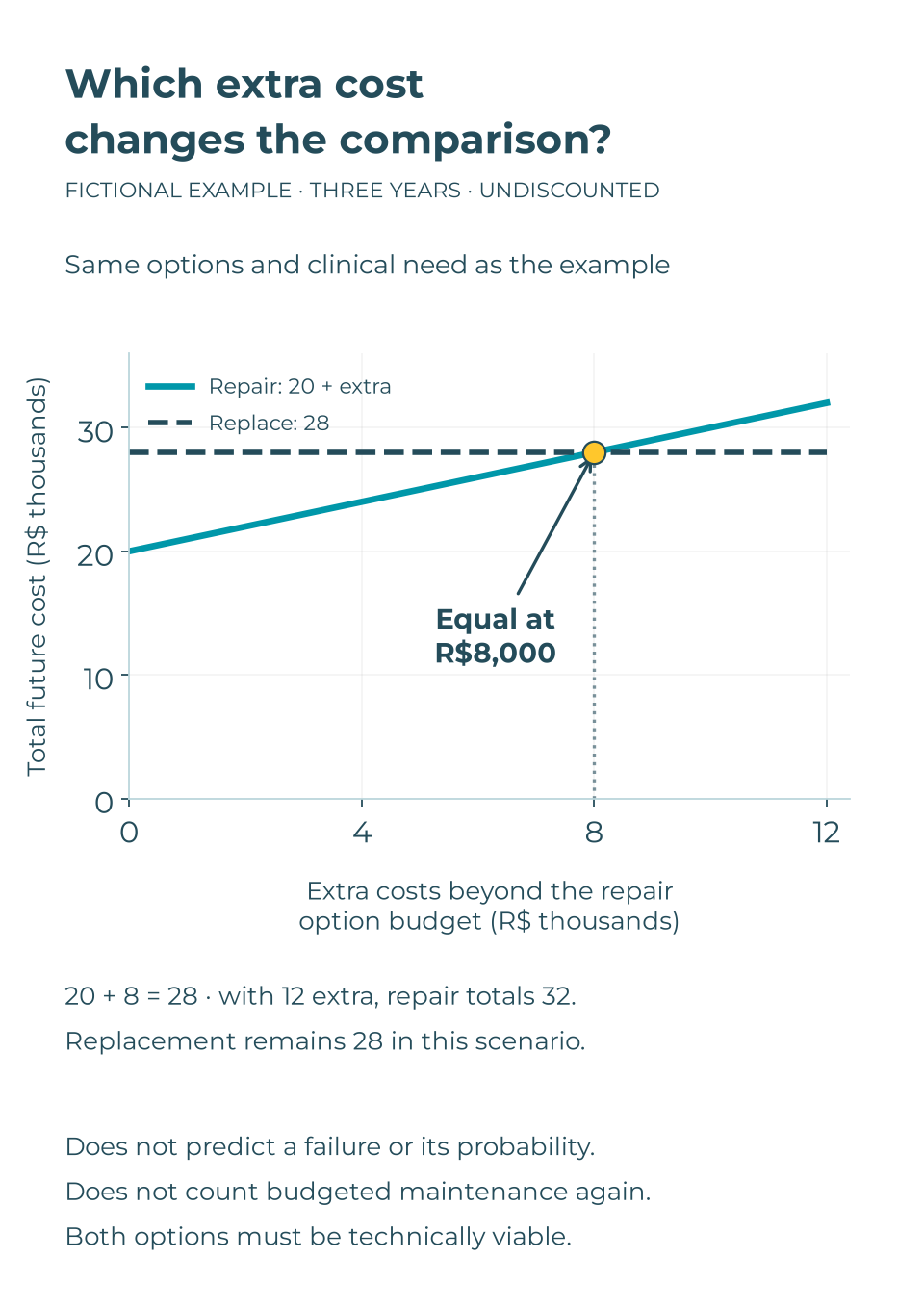
Sensitivity analysis reveals which assumption changes the decision. Investigating support, recurrence or lead time may be more valuable than negotiating only the initial part price. An arbitrary contingency is insufficient: record why the extra scenario is plausible and which information could confirm it. If replacement also has uncertain expenses, update the comparison with those inputs; this chart holds replacement cost fixed to explain one variable at a time.
Which records make the decision defensible?
A good analysis can be short if its inputs are verifiable. Record the asset, care need, technical restriction, alternatives, horizon, costs and sources. Distinguish confirmed quotes from estimates and record dates, because lead times and availability change.
| Record | How it improves comparison |
|---|---|
| Asset history | Separates an isolated event from recurrence |
| Cause and replaced part | Prevents counting every order as the same failure |
| Shutdown and return dates | Separates diagnosis, logistics and intervention |
| Contract and coverage | Shows included costs, exclusions and responsibilities |
| Replacement plan | Organizes procurement and transition before urgency |
| Approved decision | Preserves owner, assumptions and review triggers |
An order closed without cost or return date leaves a gap for the next analysis. Improving today’s service record helps decide the asset’s future. Start with existing data and declare gaps rather than pretending estimates are precise.
What should be retained with the approved decision?
This record is an adaptable editorial structure, not a mandatory standards form.
| Field | Information to complete |
|---|---|
| Need and feasibility | Required service, restrictions, technical assessment and acceptable alternatives |
| Comparison basis | Horizon, currency, price date, discount or absence of discount |
| Inputs and sources | Quotes, contracts, history and estimates, with their dates |
| Sensitivity | Cost or lead time that changes the comparison and information still needed |
| Approval and follow-up | Owner, chosen option, rationale and review triggers |
Where does Arkmeds CMMS support the decision?
When history is spread across spreadsheets, messages and files, finding inputs already consumes part of the analysis. Arkmeds CMMS brings together asset registration, orders, history, planning and reports. Device-level indicators and records organize the evidence supporting repair, contingency or replacement.

The concrete benefit is retrievable history for checking assumptions: what failed, what was done, how long it was unavailable and which decision was approved. The platform supports organization and monitoring; it does not automatically determine disposal or promise a savings percentage.
Make fleet history a foundation for decisions
Explore Arkmeds CMMS features for assets, service work and reports within one workflow.
Explore CMMSAdditional questions
Is the rule of repairing up to 50% of a new device’s price sufficient?
It can be an internal filter, but does not replace technical assessment or future cost. A repair below the limit can have an unacceptable lead time or no support; one above it may be justified by expensive or unavailable alternatives. Explain the criterion and exceptions.
Does fully depreciated equipment have zero future cost?
No. Accounting depreciation and future expenditure differ. Maintenance, operation, downtime and decommissioning can still cost money. Book value does not establish technical condition.
Can I apply the Nepal study’s savings to my hospital budget?
Not directly. The model uses specific context, equipment, assumptions and currency units. Use its comparison structure as a reference and replace inputs with local data. Do not convert 2016 international dollars into current commercial prices as though they were quotations.
Sources and further reading
- Hillebrecht et al. (2022) — Maintenance versus replacement of medical equipment
- MHRA — Managing Medical Devices, January 2021
- WHO — Medical equipment maintenance programme overview (2011)
- Arkmeds — CMMS maintenance management platform
Research and source review: 6 October 2026. Original charts; the example in Brazilian reais and its sensitivity are illustrative, not customer results.