
Cover: conceptual AI-generated illustration following the Arkmeds identity. It does not depict an actual test or measurement.
A defibrillator or cardioverter test record needs to show which unit was assessed, what was performed and which results support the conclusion. In this article, we use the Lown analyzer and Mark II app from Arkmeds as examples of how to organize these records. Conditions, limitations and outstanding issues also need to remain in the history to support the next technical decision.
Imagine receiving “defibrillator OK” on a work order. Does that tell you that an energy test was performed? That the electrode pads are within their expiry date? That the device can be accessed at night? These are different questions. A useful record lets someone find the answer without relying on the memory of the person who visited the site.
Does normal operation mean readiness for use?
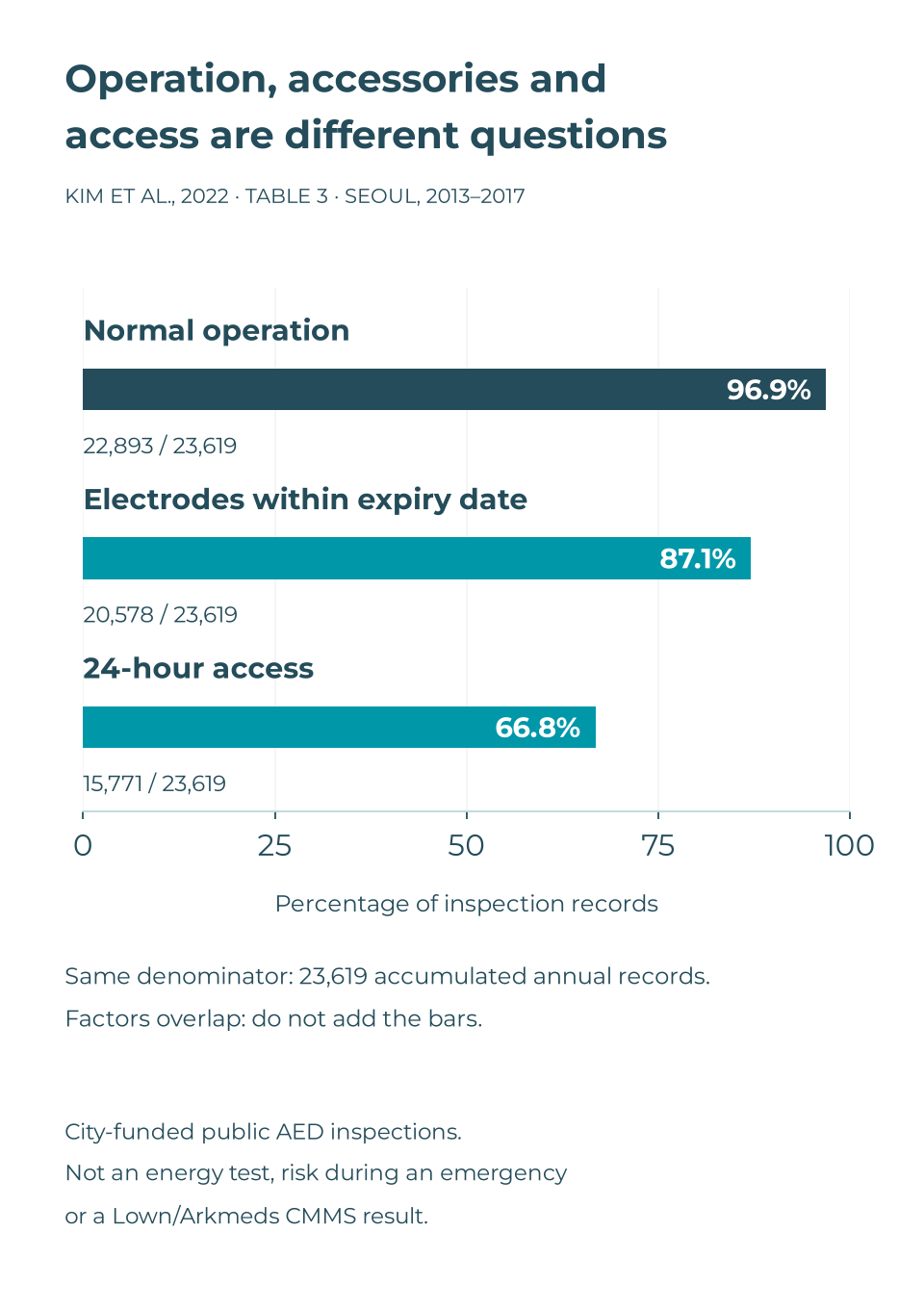
Not necessarily. Kim and colleagues analyzed annual inspections of city-funded public AEDs in Seoul between 2013 and 2017. The dataset accumulates 23,619 inspection records and should not be treated as a count of unique devices. Operation, accessories and access were observed separately.
| Condition recorded in the study | Records / total | Percentage, one decimal place |
|---|---|---|
| Normal operation | 22,893 / 23,619 | 96.9% |
| Electrodes within expiry date | 20,578 / 23,619 | 87.1% |
| 24-hour access | 15,771 / 23,619 | 66.8% |
The bars overlap and must not be added together. The same record may meet more than one condition. The study defined readiness as normal operation, good battery status and valid electrodes; 24-hour usability added access throughout that period. In Table 4, 3,646 records (15.4%) were classified as not ready, and 10,422 (44.1%) as lacking 24-hour usability.
This changes the management question: as well as “is there a report?”, ask “which condition still prevents availability?” The study’s on-site inspection was not an instrumented energy test. Its numbers do not estimate risk during an emergency, describe Brazilian hospital cardioverters or establish an effect of Lown or a CMMS. Limitations include the introduction of new devices and variation in inspectors over the years.
The publication contains discrepancies between some counts and percentages across its tables. This summary preserves the selected totals from Table 3 and the overall classifications from Table 4; it does not use them to reconstruct the distribution of causes.
Are document traceability and metrological traceability the same?
The VIM, entry 2.41, defines metrological traceability as a property of a measurement result: it can be related to a reference through a documented, unbroken chain of calibrations, each contributing to uncertainty. The vocabulary itself distinguishes this concept from the history of documents or instruments.
| Concept | Question it answers | Evidence needed |
|---|---|---|
| Document traceability | Which asset and service produced this record? | Identification, date, responsible person, version and retrievable links |
| Metrological traceability | To which reference does the measurement result relate? | Calibration chain, relevant references and uncertainties |
| Readiness and availability | Which conditions were checked and which still need action? | Documented scope, accessories, location, access and outstanding issues |
Bluetooth or a QR code alone does not demonstrate metrological traceability. They help transfer and retrieve the record. Instrument status and measurement suitability require their own evidence. Even metrological traceability does not automatically establish that uncertainty is suitable for the purpose, as VIM note 5 explains.
What should be recorded in a defibrillator test?
The MHRA’s 2021 guidance recommends retrievable records, device identification and preservation of history (§2.4). It also discusses test instruments maintained and calibrated as required, and appropriate assessment before return to service (§8.7). This is UK management guidance; the following table is an adaptable editorial synthesis, not an official form or a universal legal requirement.
| Record section | What to preserve | Why it matters |
|---|---|---|
| Identity | Model, serial number, asset ID and work order | Avoids assigning results to the wrong unit |
| Instrument | Analyzer identification and relevant metrological documentation | Allows the reference used to be retrieved |
| Scope | Functions assessed, work not performed and reasons | Avoids conclusions about functions that were not tested |
| Procedure | Document, version and applicable criteria | Makes the conclusion reviewable by another person |
| Conditions and results | Relevant configuration, units, readings and observations | Supports interpretation and comparison |
| Conclusion | Criterion applied, limitations, responsible person and next action | Links the result to the technical decision |
| Follow-up | Issue, responsible person, deadline and resolution evidence | Keeps an observation from being lost after delivery |
Selecting an energy value and writing “passed” is insufficient. Configuration context, the applicable criterion and the scope performed must accompany the conclusion. When monitoring trends, confirm comparability before interpreting differences: a change in procedure, accessory or condition may change a reading without demonstrating equipment deterioration.
Which standard should appear in the report?
The standard named must match the work performed. In the IEC catalogue, IEC 60601-2-4 covers particular requirements for basic safety and essential performance of cardiac defibrillators. IEC 62353:2014 addresses recurrent and post-repair testing of medical electrical equipment. These are not interchangeable labels for any service. See the IEC 62353 scope.
A recent update deserves attention in document control: IEC published Amendment 2 of 2026 to IEC 60601-2-4 on 28 September 2026. The official catalogue identifies the publication and its consolidated version. A new amendment calls for checking the team’s references; its existence alone does not establish automatic applicability to every device, contract or country. The complete licensed standards were not consulted for this article; no universal energy or synchronization limits are prescribed.
How can an issue be recorded without hiding the scope?
Consider this fictional documentation case, which represents neither a customer nor an Arkmeds measurement. A readiness visit to asset “AED-FIC-017” found operation indicated as normal, expired electrodes and access to the site limited to opening hours. No instrumented energy test was performed.
| Incomplete record | Record that supports follow-up |
|---|---|
| “AED OK” | Asset identification, date and scope of the readiness visit |
| “Check materials” | Expired electrodes; responsible person and next action assigned |
| “Device available” | Access hours recorded and restriction referred to management |
| “Test performed” | Checks described; instrumented energy test not performed |
| “Issue resolved” | Action, date and resolution evidence linked to the original record |
A later performance test may add another piece of evidence to the same history. It does not remove an accessory or access restriction. Likewise, electrode replacement needs its own record and does not demonstrate that an energy test was performed. Conclusions and return-to-use decisions belong to the institution’s technical process.
Where do Lown and Mark II support this flow?
When results are separated from the work order, the team must reconstruct context to deliver the report. Lown Arkmeds provides functions for assessing energy, synchronization and charge time, ECG simulation and pacemaker assessment. The official product page documents Bluetooth connectivity with Mark II, checklists, PDF reports and offline execution with later synchronization.

The practical benefit is connecting execution to the work-order record, reducing transcription steps and organizing delivery. A workflow can select the asset and scope, connect the analyzer to the app, perform the planned functions, review results and observations and make the report available to its recipient. If work takes place offline, confirm synchronization before announcing delivery. Report timing and the features used depend on the scope and operating configuration.
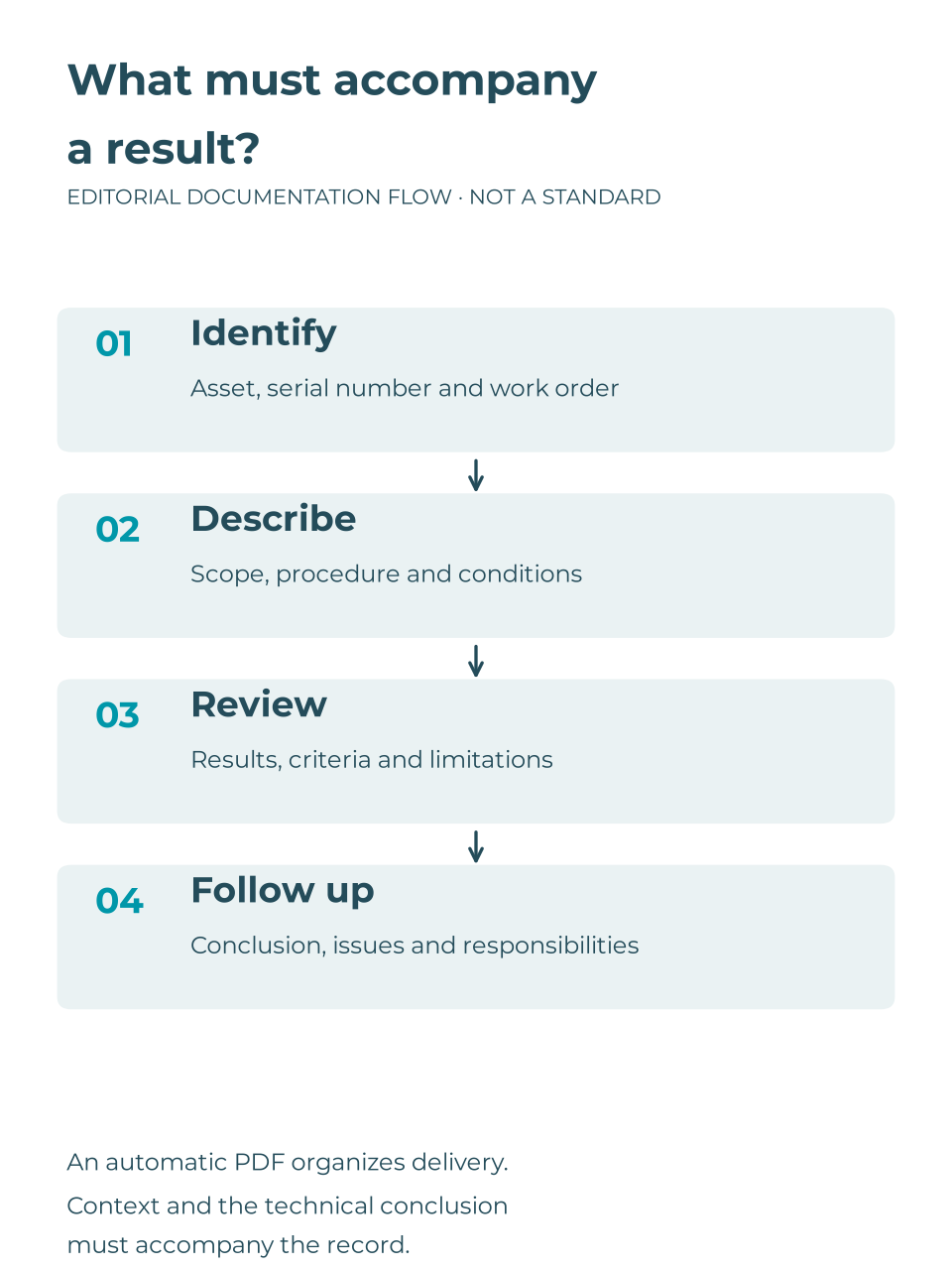
Automation must preserve work not performed and issues that still require action. The record can feed the asset history in Arkmeds CMMS, with work orders and follow-up. Software organizes information; it does not turn every outstanding issue into a pass or assign a third-party study’s results to the product.
Organize tests and reports in one flow
Explore Lown’s features and its integration with Mark II to document your team’s work.
Explore LownWhat should be checked before comparing two reports?
Confirm that they refer to the same asset, function, procedure and relevant conditions. Locate accessory changes, interventions and criteria. Then check whether readings, units and metrological documentation support the intended comparison. A numerical difference without context is still a question, not a demonstrated trend.
How can a report be corrected without losing its history?
Preserve the previous version and the reason for change, following the record-preservation principle in MHRA §2.4. Record who made the correction, when and what information changed. Correcting the document also requires assessing its effect on the earlier conclusion. An incorrect unit or a link to the wrong asset may require more than issuing another PDF. The process must allow the basis of the decision to be retrieved and relevant follow-up to be tracked.
Where can you become more familiar with Lown?
The Arkmeds channel’s video on preventive maintenance and calibration of defibrillators and cardioverters can support familiarization with the solution. The presentation is in Brazilian Portuguese. To perform servicing, use the device manufacturer’s documentation and the official Arkmeds analyzer manuals section, following the applicable procedure.
Sources and further reading
- Kim et al. (2022) — Trends in maintenance status and usability of public automated external defibrillators
- JCGM/BIPM — VIM 3, 2.41: metrological traceability
- MHRA (2021) — Managing Medical Devices
- IEC — IEC 60601-2-4:2010/AMD2:2026, official catalogue
- IEC — IEC 62353:2014, official catalogue
- Arkmeds — Lown functions and Mark II integration
- Arkmeds — CMMS and asset history
- Arkmeds — official analyzer manuals section
- Arkmeds — familiarization video: preventive maintenance and calibration of defibrillators and cardioverters
Research and review: 6 October 2026. Original chart based on Kim et al. (2022), published under CC BY 4.0. The flow and fictional case are editorial syntheses, not customer results. The historical publication date was preserved.